Section 6.4 · Further exercises · 8 of 10
Exercise 6.4.8: The evanescent light of a TIRF microscope
About the further exercises of Section 6.4
Ten further exercises in the spirit of Problems 6.4.1–6.4.6 and the home exercises, in two groups each graded from easy to harder: Exercises 6.4.1–6.4.5 on the coefficients, the critical angle and the Brewster angle, Exercises 6.4.6–6.4.10 on applications in radio, fibre optics, microscopy, radomes and metal walls. They use only the equations listed at the head of this subsection and, where stated, the normal-incidence results of Section 6.3.
The evanescent light of a TIRF microscope
#A total internal reflection fluorescence (TIRF) microscope illuminates a water-based sample () through a glass coverslip () with a laser beam that meets the glass-water interface at . (a) Find the critical angle. (b) Show that the field in the water is evanescent, and find its decay constant and the depth at which the intensity has fallen to . (c) What fraction of the surface intensity remains and into the sample? (d) Which angle of incidence gives an intensity depth of ? (e) For S polarisation find and the intensity just inside the water relative to that of the incident wave.
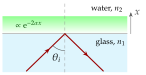
Beyond phase matching along the interface demands , so is imaginary. With the transmitted wave written as ( into the water), the choice gives a field that decays as , with
The intensity decays as .
, so is beyond it.
, and with
at and at .
: , , , .
With and ,
using . The squared field just inside the water is times that of the incident wave.
: numerator and denominator are complex conjugates, and all the power is reflected. and .
The evanescent field excites fluorescent molecules only within about of the coverslip, so the cell membrane and what is bound to it light up while the rest of the cell stays dark. The depth is tuned with the angle, as in (d). Although , no power crosses the interface on average: the evanescent wave carries power only along .
cf. Problem 6.4.2