Section 6.4 · Further exercises · 9 of 10
Exercise 6.4.9: A radome wall at an angle
About the further exercises of Section 6.4
Ten further exercises in the spirit of Problems 6.4.1–6.4.6 and the home exercises, in two groups each graded from easy to harder: Exercises 6.4.1–6.4.5 on the coefficients, the critical angle and the Brewster angle, Exercises 6.4.6–6.4.10 on applications in radio, fibre optics, microscopy, radomes and metal walls. They use only the equations listed at the head of this subsection and, where stated, the normal-incidence results of Section 6.3.
A radome wall at an angle
#A flat radome panel of a ceramic-filled composite (, lossless, nonmagnetic) is designed to be a half wave thick at for normal incidence. At oblique incidence the layer formula of Section 6.3 still holds, provided each medium is described by its transverse impedance, for S and for P polarisation, and is replaced by . (a) Find the thickness . (b) Find the S and P reflectances at , and . (c) Which thickness is transparent at ? Is it the same for both polarisations? (d) What does that panel reflect at normal incidence? (e) Show that at the Brewster angle a P wave crosses the wall without reflection whatever its thickness.
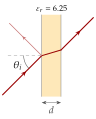
With the same medium on both sides, the slab result of Problem 6.3.3 carries over with and :
The single-interface coefficients are , which reproduce and of Eq. (6.4.13) and Eq. (6.4.29).
, , : .
At : , , , . In units of :
so and . In the same way:
Transparency needs : . The condition does not involve , so it is the same for both polarisations.
At normal incidence the panel has , , and since at normal incidence (see the check below), .
At , and : and for any . Inside, the ray meets the back face at , the Brewster angle seen from the panel, so neither face reflects.
At both equal and , the coefficient of Problem 6.3.3. The single-face S coefficient at , , agrees with Eq. (6.4.13).
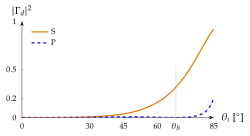
A radome wall can be made transparent at one angle only. Nose radomes see angles of and more, where S reflection rises quickly. Designers therefore choose the thickness for the most important angles and, for P polarisation, exploit the Brewster angle, where every thickness works.
cf. Problems 6.3.3, 6.4.5