Section 6.4 · Worked examples · 1 of 1
Worked example 6.4.1: Brewster windows of a He–Ne laser
A short calculation tied to Application 6.4.2. It uses only the Brewster angle and the S coefficient, and no new physics. A good way to use it: read the given quantities, produce the formulas from the application yourself, and only then put the numbers in.
Brewster windows of a He–Ne laser
#Given. He–Ne laser, . The tube is closed by plane-parallel windows of fused silica, , met by the beam at the Brewster angle. The mirrors are outside the tube.
Find. (a) and , (b) the angle at the inner face, (c) per surface and the S power left after a round trip (8 surfaces), (d) the P loss per round trip with a tilt error.
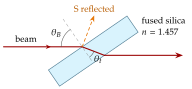
For nonmagnetic media and , Eq. (6.4.32). Each window has two faces and the beam crosses both windows twice per round trip: surfaces, each passing the fraction of the power (Figure 6.4.25).
and .
The faces are parallel, so the beam meets the glass-air face at , and : this is the Brewster angle seen from the glass. Both faces are reflection-free for P.
With , (multiply numerator and denominator by ), , :
The inner face gives (the same interface seen from the other side). After a round trip the S wave keeps of its power: it loses , the P wave nothing.
At the outer face has and . The inner face, met at , gives the same. Per round trip .
Windows at normal incidence would reflect per surface, per round trip, for both polarisations.
The gain of a He–Ne tube is a few per cent per pass, far below the S loss, so only P oscillates and the output is linearly polarised in the plane of incidence. Normal-incidence windows would cost and the laser would not lase at all, while of mis-tilt costs under .
cf. Application 6.4.2