Section 6.1 · Topic 1 of 9
6.1.1 Plane waves and the Helmholtz equation
An electromagnetic wave is called a plane wave when its sources are at infinity, that is, when the region of interest contains no sources at all. In phasor form, with the time factor suppressed, Maxwell's equations of Section 5.6 then lose their right-hand sides:
Taking the curl of , inserting and using from , exactly as in Section 5.5, gives the homogeneous Helmholtz equations
Every Cartesian component of and of therefore obeys the same scalar equation .
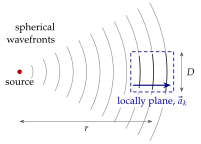
In practice "at infinity" means far away. A small source radiates spherical wavefronts, but an observer who looks at a region much smaller than its distance from the source cannot tell the curved front from a plane (Figure 6.1.1). How far is far enough? Across a width a sphere of radius departs from its tangent plane by the sagitta . The front may be treated as plane when this is a small fraction of a wavelength, and the usual criterion, , gives
A receiving dish of at () sees a plane wave from any source farther than about , a broadcast antenna a few kilometres away is far beyond that, and the sun is so far that sunlight is an excellent plane wave over any instrument we can build.
The one-dimensional solution
Let the field depend on one coordinate only, . The Helmholtz equation becomes an ordinary differential equation with constant coefficients,
whose general solution is the sum of two exponentials,
In a lossy medium is complex (Section 5.6), and we write it as
so that and
is the phase constant and the attenuation constant. Back in the time domain, with real constants and ,
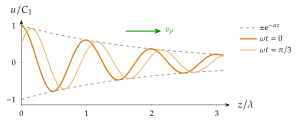
The first term is a wave travelling towards and the second one a wave travelling towards , as the next paragraph shows. Each decays in its own direction of travel: the factor of the second wave grows with , which means that it shrinks as the wave advances towards (Figure 6.1.2). In a lossless medium and .
Phase velocity and wavelength
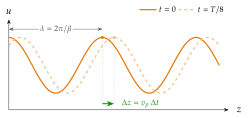
Follow a point of constant phase of the forward wave, a crest for instance:
The point moves with the phase velocity
At a fixed instant the pattern repeats when grows by , so the wavelength and the phase constant are related by
For the backward wave const gives : the same speed towards . Figure 6.1.3 shows the two snapshots.
In a lossless medium and , so
A wave is a pattern that slides along without changing shape. It covers one wavelength in one period, so its speed is . In a material the pattern is slower than in vacuum by the factor , and at the same frequency it is shorter by the same factor.
is the speed of the pattern, not of a particle and, in a dispersive medium, not of the energy either. The speed of energy and of signals, the group velocity, is the subject of Section 6.2. In vacuum the two coincide and both equal .
A wave travels in a lossless dielectric with , . Find , and .
, (against in air) and .