Section 6.1 · Topic 2 of 9
6.1.2 Plane waves in three dimensions
In three dimensions a component of a time-harmonic plane wave satisfies
We solve it by the separation of variables: assume a product of three functions of one variable each, . Substituting and dividing by ,
The first term depends on only, the second on only, the third on only, and their sum is the constant for all , , . That is possible only if each term is a constant by itself. Calling these constants , and ,
and each factor obeys an equation of the form Eq. (6.1.4): with the forward solution , and likewise , . Collecting the three numbers into the wave vector
and writing for the position vector, the solution becomes
The unit vector , also written , is the direction of propagation. Condition Eq. (6.1.15) says simply that : the length of the wave vector is fixed by the medium and the frequency, and only its direction is free.
The wavefronts
The phase of is constant where
is the distance of the point from the origin measured along , so these surfaces are planes perpendicular to , hence the name plane wave. Neighbouring crests are apart along . Along the coordinate axes the phase repeats less often. If lies in the -plane at the angle from the -axis (Figure 6.1.4), then , and
both longer than . In general, dividing Eq. (6.1.15) by ,
A point of constant phase observed on the -axis therefore runs along it at the speed , faster than .
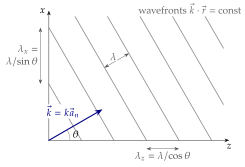
Only the intersection of a wavefront with the axis moves at , like the point where a breaking wave meets a straight beach, which runs along the shore faster than the water moves. No energy and no signal travels that fast. The same geometry returns in waveguides, where two plane waves zig-zag between metal walls (Section 7.2), and Exercise 6.1.17 builds such a guide from two crossing plane waves.
A wave in free space travels in the -plane at from the -axis. Find , and the speed of the phase along .
, , and the phase runs along at . Along , .