Section 6.1 · Topic 3 of 9
6.1.3 Uniform plane waves and the intrinsic impedance
Let us now take the electric field of a plane wave to be of the form
with a constant vector, and find the magnetic field that goes with it from the first Maxwell equation, . The curl of a scalar function times a vector is (Section 2.2), and here , whose gradient is . Hence
With and the factor is , and
The quantity is the intrinsic impedance (or wave impedance) of the medium, written in some texts. In the same way, the magnetic field substituted into the second Maxwell equation, , gives , that is
The divergence equations add the last piece of information. Since ,
Neither field has a component along the direction of propagation. Equation (6.1.23) then says that is turned by about and divided by .
A plane wave , , in a medium has
, the three form a right-handed triad, , and .
In a plane wave the electric and the magnetic field lie in the wavefront, at right angles to each other, and their ratio is a property of the medium alone. Know one of them and the direction of travel, and you know the other.
Such waves are called uniform plane waves, or TEM waves (transverse electromagnetic): no field component along , and the same amplitude everywhere on a wavefront. Figure 6.1.5 shows the triad on one wavefront.
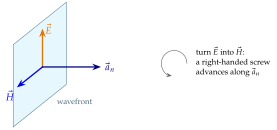
The uniform plane wave in free space
In vacuum, and to within in air, and :
An -polarised wave travelling towards has
exactly the wave of Section 5.1. In a lossless medium is real, so and are in phase: they reach their maxima at the same points and the same instants (Figure 6.1.6). In a medium with and , .
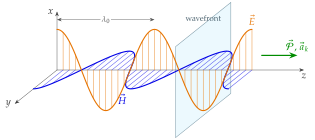
Turn the wave in 3-D and change , and : and stay in phase, follows , and points along the direction of travel.
For a wave towards , with or , the unit vector in is . Writing out of habit gives an of the wrong sign, and the wave then carries its power the wrong way. A quick check every time: must point along the direction read from the exponent (Home exercise 6.1.8).
In free space . Find .
and , so . Check: , the direction of travel.