Section 6.1 · Topic 4 of 9
6.1.4 Propagation and attenuation constants
The general form of a uniform plane wave is with . In a conducting medium the current joins the displacement current, and the wave number becomes
with the complex permittivity of Section 5.6. The wave number is now complex and is composed of the attenuation and the phase constant as in Eq. (6.1.6). Many books, and Section 6.2, use instead the propagation constant
The two descriptions are the same: . Both and are positive for a wave that travels and decays towards .
With loss the intrinsic impedance is complex too,
and since , the phase of is that of minus : the magnetic field lags the electric field by . For a medium with and real the angle stays in the range , the upper limit being approached by a very good conductor. Figure 6.1.7 shows both fields for .
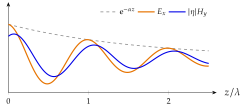
The explicit and of dielectrics, conductors and plasmas are worked out in Section 6.2. In the rest of this section the medium is lossless unless stated otherwise: , , and is real. Exercise 6.1.6 is the one exception, a concrete wall whose and are found from a measured and .