Section 6.1 · Topic 5 of 9
6.1.5 Power flow and the Poynting vector
A wave carries energy: sunlight warms, a radio wave drives a current in a receiving antenna. This subsection introduces the vector that describes the flow of electromagnetic energy, derives the energy balance it obeys, and then applies it to the plane wave.
The Poynting vector
The power density associated with an electromagnetic wave, the Poynting vector, is defined in the time domain by
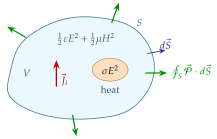
Its units are , a power per unit area. The surface integral of gives the total power passing through a surface in the direction of (Figure 6.1.8):
is perpendicular to both and . For a wave it points the way the energy travels, along in a plane wave, as Figure 6.1.6 already showed. That really is a flow of energy, and not just a convenient product, is the content of Poynting's theorem below.
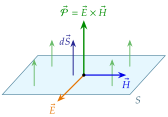
For time-harmonic fields is the product of two sinusoids of frequency , so it oscillates at . What an instrument measures, a bolometer, a thermometer or your skin, is its average over a period.
The time-average power density
In time-harmonic form the vector
is called the complex Poynting vector, the asterisk denoting the complex conjugate. Its real part is the average value of over a period, the time-average power density:
and its surface integral gives the time-average power through ,
The real part of is active power: energy that really leaves through and does not come back. The imaginary part is reactive: energy flowing back and forth with no net transport, like the reactive power of a circuit.
Why does the average carry the factor and the conjugate? Write the real part out with :
Multiplying out, the four products pair into two complex numbers and their conjugates, and , so that
The second term averages to zero over a period, which leaves the constant one.
The product of two sinusoids is a constant plus a sinusoid at twice the frequency. The constant is the average, and with phasors it is half the real part of , exactly as the average power of a circuit is .
An example shows the role of the phase. Take and with real , . In the time domain
so , which is exactly . Figure 6.1.9 plots for three phase differences.
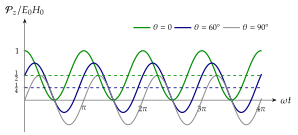
, without the conjugate, depends on the arbitrary phase reference and is not the average of anything. , without the half, is twice the average. The half belongs to amplitude phasors, the convention of this book. With rms phasors, , the average is and the half disappears.
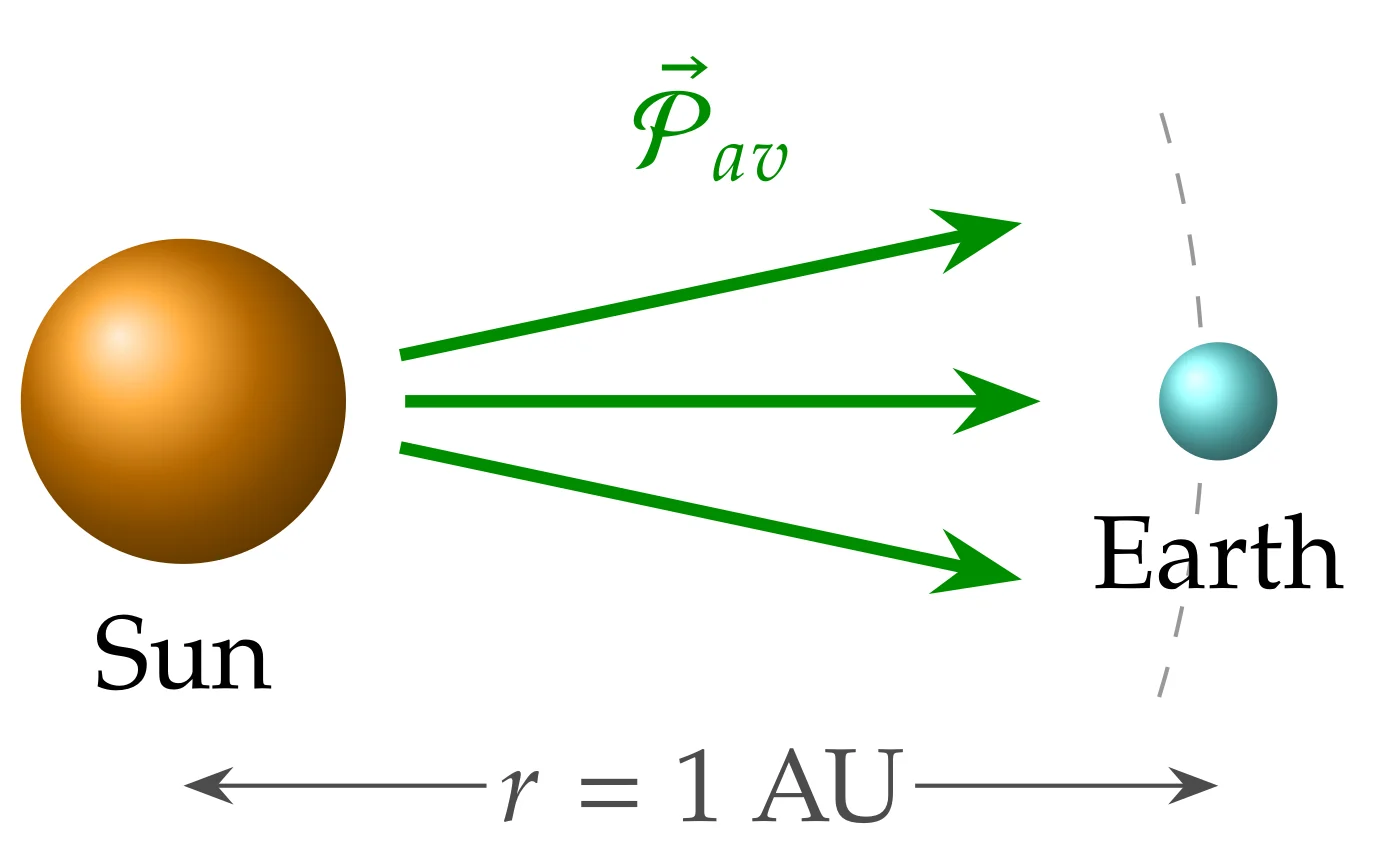
Satellites measure the power of sunlight crossing held normal to the rays above the atmosphere, at the mean Sun–Earth distance of one astronomical unit (). This total solar irradiance, the solar constant, is , and it is the magnitude of . Sunlight is broadband and incoherent: its countless frequency components have random phases, and their powers simply add. We can still describe it by one equivalent plane wave that carries the same power density. The part of this subsection on the power carried by a plane wave, below, shows that a plane wave in free space has , so
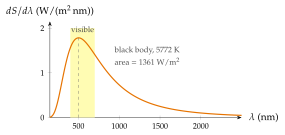
In empty space nothing absorbs the light, so is radial and its flux is the same through every sphere round the sun. Hence , and the power that leaves the sun is . Figure 6.1.10 shows where this power sits in the spectrum. Modelled as a black body at , the sun has its peak at , of lies in the visible band from to and beyond , in the infrared. At the ground about remain on a clear day, and a solar panel of efficiency turns of it into electricity. Worked example 6.1.4 carries the numbers to Mars.
is not a field that anybody measures in sunlight: no single component of the light has this amplitude. It is the amplitude of the one monochromatic plane wave that would carry the same . A kilovolt per metre sounds large, yet free space stores only a few microjoules per cubic metre at this field. It is a poor store of energy but a fast carrier.
Poynting's theorem
That is a flow of energy follows from Maxwell's equations themselves. Consider a volume bounded by the closed surface with outward , filled with a linear medium that does not change in time, and containing sources described by an impressed current density (Figure 6.1.11). The total current density is then .
Step 1. A vector identity. From Section 2.2,
Step 2. Insert Maxwell's curl equations, and :
Step 3. Recognise the stored energies. In a linear medium that does not change in time, and with constant , , so
These are the time derivatives of the magnetic and electric energy densities and of Section 4.2 and Section 3.4.
Step 4. Integrate over and turn the left-hand side into a surface integral with the divergence theorem (Section 2.4), . Rearranging,
Every term is a power in watts, an energy per unit time. Read term by term:
- the first term on the left is the power pumped into through by external sources,
- the second term on the left is the power provided by the internal sources, the impressed current density ,
- the first term on the right is the rate of increase of the electromagnetic energy stored in , with the densities and ,
- the second term on the right is the power dissipated in as heat, Joule's law of Section 4.2.
The field carries energy like a fluid. What the sources give is either stored in the field, turned into heat, or carried out through the boundary at the rate . Nothing is created or lost: Poynting's theorem is the conservation of energy, written locally.
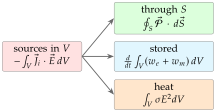
A source whose impressed current points along absorbs power, like a resistor or a charging battery. One with against delivers power, which is why is the power supplied. A battery driving a current through a load does exactly this inside itself: the chemical forces push the charges against the field.
Poynting's theorem in time-harmonic form
The same steps work with phasors. Start from the identity with the conjugate field, , and insert and the conjugate of the second Maxwell equation, :
Multiply by , so that the left-hand side becomes , integrate over , use the divergence theorem and take the real part:
Averaged over a period, the power that enters through the boundary or is supplied by the sources can go to one place only: heat. The stored energy rises and falls twice per period but, on average, takes nothing.
The left-hand side is the time-average power entering through plus the time-average power supplied by the sources inside . The second term on the right, per unit volume, is the time-average Joule heat, half the peak value of . The first term on the right deserves a closer look. Over a full period the stored energy returns to its starting value, so on average it neither grows nor falls. Indeed, with real and the products and are real, the bracket is imaginary, and its real part is zero. Its imaginary part,
is the reactive power: it appears in the imaginary part of the same balance, which is not written out here. If the permittivity is complex, , then and the real part of the first term becomes : the dielectric loss, heat just like that of . This is how a microwave oven heats water (Section 5.6).
A region is filled with a lossless medium and contains no sources. A standing wave lives in it. What does the time-harmonic theorem say about the net power through its boundary?
With , no and real , , every term but the first vanishes on average: . Energy may slosh in and out, but no net power crosses (Home exercise 6.1.5).
The power carried by a plane wave
For in a lossless medium, and the instantaneous Poynting vector is
It pulsates at between zero and but never points backwards. Its time average follows from the phasors for any uniform plane wave. With and the identity ,
because .
For a uniform plane wave of any polarisation in a lossless medium,
With loss, and , so for a wave travelling along .
A plane wave carries the power density along its direction of travel, the field analogue of . Every component of contributes its own share, whatever their relative phases.
Two more facts complete the picture. The electric and magnetic energy densities are equal at every point and every instant, since gives . And the energy moves at the speed
where . In a lossless, non-dispersive medium energy and phase travel together.
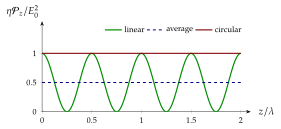
Figure 6.1.12 compares a linearly and a circularly polarised wave with the same peak field per component. The circular wave of Problem 6.1.4 has two components of amplitude in time quadrature, its never changes, and its power density is constant, twice the average of the linear one. Polarisation is the subject of the next subsection.
A plane wave in free space has . Find and .
and . One volt per metre is a strong signal, found only within a few kilometres of a broadcast transmitter, and it carries about a milliwatt per square metre.