Section 6.1 · Topic 7 of 9
6.1.7 The Doppler effect
When a time-harmonic source and a receiver move relative to each other, the frequency of the received wave differs from the frequency of the emitted one. This is the Doppler effect, named after C. Doppler (1803–1853), who described it for sound and light in 1842.
A moving source
Let the source T move with the constant velocity , at the angle to the line from T to the receiver R, which is at rest (Figure 6.1.20, left). The peak value of the wave emitted by T at , when the distance is , arrives at R after
One period later T emits the next peak. By then it has moved metres from its original location, to the distance from R (Figure 6.1.20, right), and this peak arrives at R at
The interval between the two receptions, , is the period seen by the receiver.
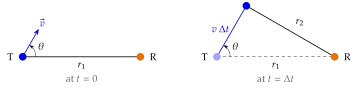
By the law of cosines in the triangle of the right-hand figure,
where was dropped because the source moves only a tiny distance in one period, . For the same reason the second term under the root is small, and with for ,
The frequency of the original wave is , and the frequency of the received wave is
the last step using for .
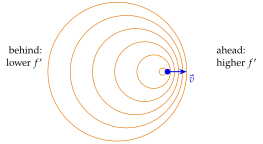
That means that if the source is getting closer, , the frequency increases. This is the reason for the blue shift of approaching objects in astronomy. If the source moves away, , the frequency decreases, the red shift of receding galaxies. At the source moves across the line of sight and, to first order, there is no shift at all. Figure 6.1.21 gives the picture: the wavefronts emitted at equal time steps crowd together ahead of the moving source and spread out behind it. This mechanism constitutes the basis of the continuous-wave (CW) radar.
Press Play below to follow the beacon of a satellite at on an overhead pass at (Problem 6.1.5), and watch the shift sweep through zero at closest approach at on a straight track, or at with the toggle for the orbit round the Earth.
A moving observer, and the radar echo
Let now T be at rest and the receiver R move with the speed at the angle to the line from R to T. The crests, spaced by , sweep past R with the relative speed , so R counts
the same result as for the moving source, to first order in . For electromagnetic waves only the relative velocity of source and observer can matter, by special relativity, and the exact head-on formula differs from both classical expressions only in terms of order . Expanding, , against for the moving source, Eq. (6.1.69), and for the moving observer, Eq. (6.1.70). At the speeds of cars, aircraft and satellites, , the difference is far below anything that matters.
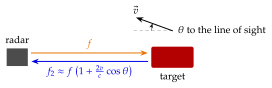
A radar echo combines both cases. A target moving with at the angle to the line of sight first receives the radar's wave as a moving observer, at , then re-radiates as a moving source (Figure 6.1.22):
To first order in , a moving source or a moving observer shifts the frequency to
where is the angle between the velocity and the line towards the other party. The echo of a target moving at is shifted by the two-way Doppler shift
Moving towards the wave, or moving the source towards you, squeezes the crests together in time. One trip changes the frequency by the fraction , a radar echo makes the trip twice.
The two-way shift is used wherever speed is to be measured without contact: police radar (Application 6.1.5), weather radar, which sees rain moving towards or away from it, aircraft and missile tracking, the orbit determination of satellites (Problem 6.1.5), and the Doppler log of ships. Ultrasound Doppler in medicine uses the same law with the speed of sound in place of .
A car approaches an X-band speed gun () head-on at (). What is the Doppler shift of the echo?
, an audio tone. The relative shift is .
A source or an observer in motion gives the one-way shift . A radar looking at a moving reflector gives twice that. Mixing the two halves or doubles every speed derived from a measured shift. The angle is always measured between the velocity and the line of sight, so motion across the line of sight gives no first-order shift.
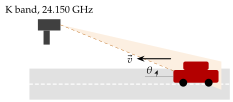
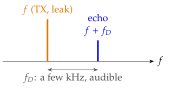
The physics. A continuous-wave (CW) radar transmits a single frequency . The car reflects it with the two-way Doppler shift, and the receiver multiplies (mixes) the echo with a sample of the transmitted wave: the difference frequency is the Doppler tone,
The shift is tiny, at , but after mixing it is an audio tone of a few kilohertz, counted or Fourier-transformed in a fraction of a second (Figure 6.1.23). Stationary objects return exactly and are filtered out. Table 6.1.3 gives the shift per unit speed in the three radar bands used by the police.
The cosine error. The gun measures only the component of the velocity along its beam, so the reading is always low: by at and by at (Worked example 6.1.5). The error always favours the driver, and the officer aims far ahead along the road to keep small.
Table 6.1.3. Doppler shift of a police radar per unit speed of the target, , head-on.
| band | per km/h | |
|---|---|---|
| X | ||
| K | ||
| Ka |