Section 6.1 · Further exercises · 11 of 17
Exercise 6.1.11: A laser Doppler vibrometer
About the further exercises of Section 6.1
Seventeen further exercises in the spirit of the problems, the home exercises and the worked examples, graded from easy to harder within each group. Exercises 6.1.1–6.1.4 are about uniform plane waves, , , and the triad, Exercises 6.1.5–6.1.6 about power, energy and loss, Exercises 6.1.7–6.1.10 about polarisation, Exercises 6.1.11–6.1.12 about the Doppler effect, and Exercises 6.1.13–6.1.17 mix power, exposure and polarisation. Besides the relations listed at the head of this subsection they use the lossy forms , , and (Exercise 6.1.6 only), the average energy density , Faraday's law , and the polarisation match . A field factor is .
A laser Doppler vibrometer
#A helium-neon laser () is aimed along the normal of a surface that vibrates as with and . (a) Find the velocity amplitude of the surface. (b) Find the largest Doppler shift of the reflected light and the relative shift . (c) Why is the shift measured by beating the echo with a reference beam rather than by measuring the echo frequency? (d) The reference is offset by in a Bragg cell so that the sign of the velocity can be read. Up to which surface speed does this work?
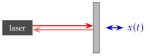
The surface first receives the light as a moving observer and then re-radiates it as a moving source: the two-way shift of Eq. (6.1.73) with .
, so .
At most
The light itself is at , and no counter resolves one part in of that. Mixing the echo with a sample of the laser on a photodiode produces the difference frequency directly, an audio-band signal: the optical version of the radar mixer of Application 6.1.5.
The beat is at . It stays positive while , that is .
Units: (m/s)/m Hz. The velocity amplitude is the usual one of a harmonic motion.
The beat frequency swings between a thousand times a second, and demodulating it gives : a displacement of one micrometre is measured without contact. Vibrometers resolve surface velocities of micrometres per second, and are used on loudspeaker cones, car bodies and MEMS devices.
cf. Worked example 6.1.5