Section 6.1 · Further exercises · 12 of 17
Exercise 6.1.12: Speed and miss distance from a Doppler record
About the further exercises of Section 6.1
Seventeen further exercises in the spirit of the problems, the home exercises and the worked examples, graded from easy to harder within each group. Exercises 6.1.1–6.1.4 are about uniform plane waves, , , and the triad, Exercises 6.1.5–6.1.6 about power, energy and loss, Exercises 6.1.7–6.1.10 about polarisation, Exercises 6.1.11–6.1.12 about the Doppler effect, and Exercises 6.1.13–6.1.17 mix power, exposure and polarisation. Besides the relations listed at the head of this subsection they use the lossy forms , , and (Exercise 6.1.6 only), the average energy density , Faraday's law , and the polarisation match . A field factor is .
Speed and miss distance from a Doppler record
#A CW radar at watches an aircraft that flies straight and level at constant speed and passes the radar at the closest distance . The recorded Doppler shift starts near , falls through zero at the moment of closest approach with the slope and ends near . (a) With at closest approach, show that . (b) Find . (c) Find . (d) How long does take to fall from to of its far value?
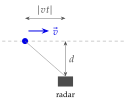
The geometry of Home exercise 6.1.6 with the two-way shift: the radial velocity component is with . The far values give , the slope at the zero crossing gives .
Put the track along with the aircraft at and the radar at the foot of the perpendicular, a distance below. The component of the velocity towards the radar is , positive while (approaching), and the two-way shift is the stated formula.
For , with :
Near , , so the slope is :
where , so the time is .
: the first-order Doppler formula is exact for all practical purposes, and the shift of a few kHz on is the audio tone of Application 6.1.5.
One stationary CW radar thus gives speed and miss distance from the shape of a single Doppler curve, with no range measurement at all: the far values give , the steepness of the zero crossing gives . The same idea locates ships from a satellite's Doppler curve (Problem 6.1.5).
cf. Home exercise 6.1.6