Section 6.1 · Further exercises · 13 of 17
Exercise 6.1.13: The fields of a laser pointer
About the further exercises of Section 6.1
Seventeen further exercises in the spirit of the problems, the home exercises and the worked examples, graded from easy to harder within each group. Exercises 6.1.1–6.1.4 are about uniform plane waves, , , and the triad, Exercises 6.1.5–6.1.6 about power, energy and loss, Exercises 6.1.7–6.1.10 about polarisation, Exercises 6.1.11–6.1.12 about the Doppler effect, and Exercises 6.1.13–6.1.17 mix power, exposure and polarisation. Besides the relations listed at the head of this subsection they use the lossy forms , , and (Exercise 6.1.6 only), the average energy density , Faraday's law , and the polarisation match . A field factor is .
The fields of a laser pointer
#A green laser pointer emits at in a beam of diameter. Treat the beam as a uniform plane wave of uniform intensity over its cross-section. (a) Find the time-average power density. (b) Find the amplitudes and rms values of and . (c) Find the average energy density and the energy contained in one metre of the beam. (d) The lens of the eye focuses the beam to a spot of about diameter on the retina. Estimate the power density and the field amplitude there (ignore absorption in the eye and the refractive index of the vitreous body). (e) How many wavelengths fit across the beam, and why does that justify the plane-wave model?
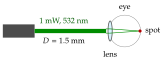
Power over area gives . In air gives the field, and the energy density, since the energy of a plane wave travels at , Eq. (6.1.52). Focusing changes only the area.
and .
and , .
. One metre of the beam holds .
The area shrinks by :
. Across so many wavelengths the wavefronts are flat and the fields uniform, so locally the beam is a uniform plane wave with .
, and with .
The beam itself is about half as intense as sunlight, with . The danger lies in its collimation: the eye focuses it to a spot times more intense, while the image of the extended sun is far larger. This is why even a few milliwatts are classified as hazardous for direct viewing.
cf. Problem 6.1.8