Section 6.1 · Further exercises · 14 of 17
Exercise 6.1.14: Exposure near a weather radar
About the further exercises of Section 6.1
Seventeen further exercises in the spirit of the problems, the home exercises and the worked examples, graded from easy to harder within each group. Exercises 6.1.1–6.1.4 are about uniform plane waves, , , and the triad, Exercises 6.1.5–6.1.6 about power, energy and loss, Exercises 6.1.7–6.1.10 about polarisation, Exercises 6.1.11–6.1.12 about the Doppler effect, and Exercises 6.1.13–6.1.17 mix power, exposure and polarisation. Besides the relations listed at the head of this subsection they use the lossy forms , , and (Exercise 6.1.6 only), the average energy density , Faraday's law , and the polarisation match . A field factor is .
Exposure near a weather radar
#An S-band weather radar () sends pulses of duration at a repetition frequency of . On the axis of its beam, at , the power density during a pulse is . (a) Find the peak amplitudes of and there. (b) Find the time-average power density for a beam that stays pointed at the observer, and the amplitude of the CW wave with the same average. (c) In operation the beam, wide, turns steadily through in azimuth. What average power density does the observer receive then? (d) Compare (b) and (c) with the limit of Problem 6.1.8 at this frequency. Assuming , find the distance on the axis inside which a stationary beam would exceed the limit, and the peak field there.
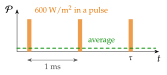
During a pulse the wave is locally plane, so the peak power density gives the peak field. Averages are peak values times the fraction of time the observer is illuminated: the duty cycle , and for a turning beam also the fraction of a turn spent in the beam.
and .
The duty cycle is , so . A CW wave carrying the same average has .
A beam turning through covers the observer of the time: .
At rule (ii) of Problem 6.1.8 gives . The stationary beam stays times below it at , the rotating one more than times. With the limit is reached at
The CW amplitude of (b) is of the peak: .
For pulsed fields the standards limit the average and the peak: the IEEE standard caps the peak electric field at , far above the found here. The law is optimistic close to a large dish, whose near-field beam is roughly collimated so that the power density there saturates, and real safety distances are computed with the antenna's near-field model. The rotating-beam figure explains why people living near such radars receive only milliwatts per square metre.
cf. Problem 6.1.9