Section 6.1 · Further exercises · 15 of 17
Exercise 6.1.15: A loop probe in a circularly polarised wave
About the further exercises of Section 6.1
Seventeen further exercises in the spirit of the problems, the home exercises and the worked examples, graded from easy to harder within each group. Exercises 6.1.1–6.1.4 are about uniform plane waves, , , and the triad, Exercises 6.1.5–6.1.6 about power, energy and loss, Exercises 6.1.7–6.1.10 about polarisation, Exercises 6.1.11–6.1.12 about the Doppler effect, and Exercises 6.1.13–6.1.17 mix power, exposure and polarisation. Besides the relations listed at the head of this subsection they use the lossy forms , , and (Exercise 6.1.6 only), the average energy density , Faraday's law , and the polarisation match . A field factor is .
A loop probe in a circularly polarised wave
#A right-hand circularly polarised wave travels towards in air at with : . A one-turn loop of radius is centred at the origin. (a) Check that the wave is RHCP and find and . (b) The normal of the loop lies in the -plane at the angle from . Show that the emf has the same amplitude for every , find it, and find how its phase depends on . (c) What does the loop give with its normal along ? (d) Repeat (b) for the LHCP wave . (e) An unknown wave gives emf amplitudes between and as the loop is turned about , and the phase of the emf increases as the normal turns from towards . What are its axial ratio and its hand?
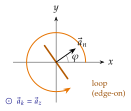
The loop is small, against , so with at the centre, and (Problem 6.1.7). The complex projection carries both the amplitude and the phase, and the phase is what knows the hand.
, : , and the two are equal and perpendicular: RHCP. The two components carry equal power, , so . With ,
and at
The amplitude does not depend on :
and the phase is : turning the loop from towards delays its emf by the same angle, .
: no flux, no emf.
Now and , so : the same , but the phase now increases with .
swings between the semi-minor and the semi-major axis of the ellipse, which is the ellipse turned by . So (). By (b) and (d), a phase that increases as the normal turns about means a left-handed wave.
With () only links the loop: , and lags by , as predicts. For the elliptical wave the mean square of the emf over a turn is , the value a circular wave of the same power would give at every angle.
Two crossed loops (normals along and ) whose outputs are combined through a phase shifter add for one hand and cancel for the other: by (b) and (d) the RHCP wave gives and the LHCP wave . This is a simple circularly polarised receiving antenna, the principle behind the crossed loops and crossed dipoles of satellite ground stations.
cf. Problem 6.1.7