Section 6.1 · Further exercises · 16 of 17
Exercise 6.1.16: Circular polarisation in an oblique direction
About the further exercises of Section 6.1
Seventeen further exercises in the spirit of the problems, the home exercises and the worked examples, graded from easy to harder within each group. Exercises 6.1.1–6.1.4 are about uniform plane waves, , , and the triad, Exercises 6.1.5–6.1.6 about power, energy and loss, Exercises 6.1.7–6.1.10 about polarisation, Exercises 6.1.11–6.1.12 about the Doppler effect, and Exercises 6.1.13–6.1.17 mix power, exposure and polarisation. Besides the relations listed at the head of this subsection they use the lossy forms , , and (Exercise 6.1.6 only), the average energy density , Faraday's law , and the polarisation match . A field factor is .
Circular polarisation in an oblique direction
#A plane wave in air has the electric field
(a) Find , and the direction of propagation, and check that is transverse. (b) Determine the polarisation (type and hand). (c) Find and check that it has the same polarisation. (d) Find and the power crossing of the plane . (e) Write and follow its tip from to .
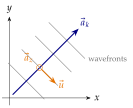
The exponent is with . Once is known, the handedness test works for any direction, not only along the axes.
, and , at between and . Transverse: and .
and with the unit vector . and : circular. The hand:
right-handed: RHCP.
and , so and
Test: , , : also RHCP.
, so
Through of the plane , whose normal is : , that is .
: from at to at , a rotation about , counter-clockwise for an observer facing the wave.
: , and computed component by component gives .
A short dipole along sees only : of the field amplitude of the circle, so half of what a dipole along or along would deliver. Projecting a circular wave on a direction that is not transverse always loses part of it.
cf. Problem 6.1.2