Section 6.1 · Further exercises · 17 of 17
Exercise 6.1.17: Two crossing waves: a waveguide in disguise
About the further exercises of Section 6.1
Seventeen further exercises in the spirit of the problems, the home exercises and the worked examples, graded from easy to harder within each group. Exercises 6.1.1–6.1.4 are about uniform plane waves, , , and the triad, Exercises 6.1.5–6.1.6 about power, energy and loss, Exercises 6.1.7–6.1.10 about polarisation, Exercises 6.1.11–6.1.12 about the Doppler effect, and Exercises 6.1.13–6.1.17 mix power, exposure and polarisation. Besides the relations listed at the head of this subsection they use the lossy forms , , and (Exercise 6.1.6 only), the average energy density , Faraday's law , and the polarisation match . A field factor is .
Two crossing waves: a waveguide in disguise
#Two plane waves of amplitude travel in air, both with along , one along , the other along , , in opposite phase at the origin:
(a) Write as a product of a function of and a wave along , and find , and along . (b) On which planes is ? (c) Find . (d) Find and the power per metre of width (along ) between and the first zero plane . (e) Find the energy per unit area of the -cross-section of that strip and the speed of the energy along , and compare with . (f) Metal plates are put at and . Why does nothing change? Below which frequency can this field not exist between them, and what are , and at ?
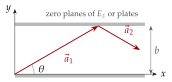
Split into its and parts. Both waves share , and their parts , , combine into a standing pattern. follows wave by wave from .
, , , and
A wave along with and , faster than light, and a standing pattern across.
: . So .
and . Adding the two waves,
with and . has a component along the direction of travel : this is not a uniform plane wave.
. is purely imaginary, so there is no average flow across, and . Hence
with :
On the planes and the field has no tangential () and no normal (): exactly the boundary conditions of a perfect conductor, so plates there change nothing. With fixed, must stay below : . At , , , and .
, as Eq. (6.1.15) requires. is also the group velocity: with fixed, and .
This is the TE mode of a parallel-plate waveguide (Section 7.2): two plane waves zig-zagging between the plates. The phase pattern runs along the guide faster than light, while the energy, carried along the zig-zag at , advances only at . At the cutoff frequency the waves bounce straight up and down () and nothing moves along the guide.
cf. Problem 6.1.2