Section 6.1 · Further exercises · 3 of 17
Exercise 6.1.3: Writing the wave for a given direction
About the further exercises of Section 6.1
Seventeen further exercises in the spirit of the problems, the home exercises and the worked examples, graded from easy to harder within each group. Exercises 6.1.1–6.1.4 are about uniform plane waves, , , and the triad, Exercises 6.1.5–6.1.6 about power, energy and loss, Exercises 6.1.7–6.1.10 about polarisation, Exercises 6.1.11–6.1.12 about the Doppler effect, and Exercises 6.1.13–6.1.17 mix power, exposure and polarisation. Besides the relations listed at the head of this subsection they use the lossy forms , , and (Exercise 6.1.6 only), the average energy density , Faraday's law , and the polarisation match . A field factor is .
Writing the wave for a given direction
#A uniform plane wave in air travels from the origin towards the point . Its electric field is linearly polarised, has the amplitude , lies in the plane containing and the direction of propagation, and has a positive -component. (a) Write the phasor . (b) Find . (c) Find the wavelengths and the phase velocities along the three axes. (d) At which first instant is at the point largest?
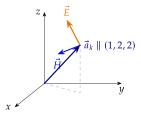
is the unit vector towards . The direction of is the part of that is transverse to : it lies in the plane of and and has a positive -component.
and (), so
Remove from its component along :
so
horizontal, of magnitude .
and :
At the phase is , so , largest when :
, , and , , are all longer than , with , as Eq. (6.1.20) requires.
The phase velocities along the axes exceed , and even three times. Nothing moves that fast: they are the speeds of the intersection points of a wavefront with the axes. The energy travels along at .
cf. Problem 6.1.2