Section 6.1 · Further exercises · 4 of 17
Exercise 6.1.4: Direction finding with three probes
About the further exercises of Section 6.1
Seventeen further exercises in the spirit of the problems, the home exercises and the worked examples, graded from easy to harder within each group. Exercises 6.1.1–6.1.4 are about uniform plane waves, , , and the triad, Exercises 6.1.5–6.1.6 about power, energy and loss, Exercises 6.1.7–6.1.10 about polarisation, Exercises 6.1.11–6.1.12 about the Doppler effect, and Exercises 6.1.13–6.1.17 mix power, exposure and polarisation. Besides the relations listed at the head of this subsection they use the lossy forms , , and (Exercise 6.1.6 only), the average energy density , Faraday's law , and the polarisation match . A field factor is .
Direction finding with three probes
#A plane wave in air arrives from an unknown direction. Small field probes sit at the origin and at , and , with vertical. Relative to the probes measure the phases at , at and at . (a) Find and , and check . (b) Give the elevation and the azimuth (from towards ) of the source. (c) Why must the probe spacing stay below ?
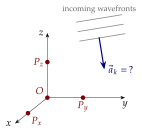
The phase of at a point , relative to the origin, is . A probe on an axis therefore reads one component of : the phase at is , and so on.
With and the phases in radians,
The free-space value is , and indeed . Hence
The source lies in the direction :
A phase is known only modulo . The largest possible phase step between two probes is , for a wave along the baseline. It stays below , so that and can be told apart, only if . With the readings are unambiguous.
. The along-axis wavelengths are and , longer than .
The vertical probe is not strictly needed for , which follows from . It decides the sign, that is whether the wave comes from above or, after a ground reflection, from below. Phase-comparison direction finders and the angle-of-arrival estimators of phased arrays work exactly this way.
cf. Problem 6.1.2