Section 6.1 · Further exercises · 5 of 17
Exercise 6.1.5: Microwave power beaming
About the further exercises of Section 6.1
Seventeen further exercises in the spirit of the problems, the home exercises and the worked examples, graded from easy to harder within each group. Exercises 6.1.1–6.1.4 are about uniform plane waves, , , and the triad, Exercises 6.1.5–6.1.6 about power, energy and loss, Exercises 6.1.7–6.1.10 about polarisation, Exercises 6.1.11–6.1.12 about the Doppler effect, and Exercises 6.1.13–6.1.17 mix power, exposure and polarisation. Besides the relations listed at the head of this subsection they use the lossy forms , , and (Exercise 6.1.6 only), the average energy density , Faraday's law , and the polarisation match . A field factor is .
Microwave power beaming
#A power beam arrives at a receiving panel as an RHCP uniform plane wave with . (a) Find , the amplitude of each field component and the amplitude of . (b) Find the energy density and check that . (c) The panel, of area , has its normal at to . Find the power intercepted, and the power collected when its elements are linear dipoles and when they are RHCP patches. (d) What peak field would a linearly polarised beam of the same have?
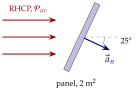
A CP wave has , so , and its tip turns on a circle of constant radius . Only the normal component of crosses the panel, and the polarisation match decides how much of that is collected.
, and
constant in time, and .
Only the normal component crosses the panel:
Linear dipoles collect of it, , whatever their orientation in the panel. RHCP patches collect all .
A linear wave with needs .
: the linear wave needs the larger peak because its power arrives in pulses.
For the same power density the CP beam has a peak field times lower than a linear one, against , which matters for air breakdown and for exposure limits that are written in V/m. And it does not care how the panel is turned about the beam axis, which is why power-beaming and satellite links prefer circular polarisation.
cf. Problem 6.1.4