Section 6.1 · Further exercises · 7 of 17
Exercise 6.1.7: Three waves to classify
About the further exercises of Section 6.1
Seventeen further exercises in the spirit of the problems, the home exercises and the worked examples, graded from easy to harder within each group. Exercises 6.1.1–6.1.4 are about uniform plane waves, , , and the triad, Exercises 6.1.5–6.1.6 about power, energy and loss, Exercises 6.1.7–6.1.10 about polarisation, Exercises 6.1.11–6.1.12 about the Doppler effect, and Exercises 6.1.13–6.1.17 mix power, exposure and polarisation. Besides the relations listed at the head of this subsection they use the lossy forms , , and (Exercise 6.1.6 only), the average energy density , Faraday's law , and the polarisation match . A field factor is .
Three waves to classify
#Determine the polarisation (type and hand, IEEE convention) and the direction of propagation of
- (a) ,
- (b) ,
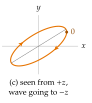
- (c) . For this wave also find the axial ratio, the tilt of the major axis and the circular components.
Bring each wave to the form of the recipe: the direction from the phase, the field at the origin at and , the hand against . For (c), which travels towards , use a transverse basis with .
, so both components have the same time function:
A linear wave in disguise, along , with the peak , towards .
Towards , . At : at , at , constant length: circular. The rotation axis is : LHCP.
: towards . At , and . The tip passes at , at and at : clockwise seen from , that is a rotation about . Right-handed elliptical. In the right-handed transverse basis , () the phase of relative to is : RH, in agreement.
(along ), , : , and
In the basis : , so and :
, and . of the power of (c) is RHCP.


cf. Problem 6.1.1