Section 6.1 · Further exercises · 8 of 17
Exercise 6.1.8: From a measured ellipse back to the phasor
About the further exercises of Section 6.1
Seventeen further exercises in the spirit of the problems, the home exercises and the worked examples, graded from easy to harder within each group. Exercises 6.1.1–6.1.4 are about uniform plane waves, , , and the triad, Exercises 6.1.5–6.1.6 about power, energy and loss, Exercises 6.1.7–6.1.10 about polarisation, Exercises 6.1.11–6.1.12 about the Doppler effect, and Exercises 6.1.13–6.1.17 mix power, exposure and polarisation. Besides the relations listed at the head of this subsection they use the lossy forms , , and (Exercise 6.1.6 only), the average energy density , Faraday's law , and the polarisation match . A field factor is .
From a measured ellipse back to the phasor
#A wave travelling towards in air is found to be right-handed elliptically polarised. Its ellipse has the semi-axes and , and the major axis makes with the -axis. (a) Write the phasor (up to a common phase). (b) Verify and with the formulas, Eq. (6.1.58). (c) Find , and the fraction of the power an RHCP antenna receives. (d) A linear antenna can be turned about the -axis to the angle from . At which does it receive most and least, and which fractions of the power?
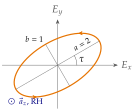
In the frame of its own axes, along the major axis and along the minor axis with , an RH ellipse is : it turns from to , like . Then rotate back to and .
, :
Dropping the common phase :
: RH, as required.
, , and :
From the axes directly, and . An RHCP antenna receives
A linear antenna at has the real polarisation vector . With and ,
The maximum, , is reached with the antenna along the major axis, , the minimum, , along the minor axis, .
.
Turning a linear antenna is a practical way of measuring an ellipse: the angle of the maximum gives the tilt , and the ratio of the maximum to the minimum received power is , here , that is . It does not give the hand. For that a CP antenna, as in part (c), or the phase between two orthogonal probes is needed (Exercise 6.1.15).
cf. Problem 6.1.3