Section 6.1 · Home exercises · 3 of 8
Home exercise 6.1.3: Three polarisers
Three polarisers
#Unpolarised light of intensity falls on an ideal polariser with a vertical axis.
- What intensity leaves it?
- A second polariser with a horizontal axis is placed behind the first. What leaves now?
- A third polariser with its axis at to the vertical is slipped between the two. Find the transmitted intensity as a function of , its maximum and the at which it occurs.
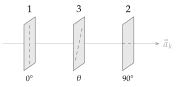
Malus' law, Eq. (6.1.63), sheet by sheet. Each sheet passes the projection of the field on its axis and leaves the light polarised along that axis.
Unpolarised light loses half: , now vertically polarised.
The horizontal sheet is at to the field: (crossed polarisers).
Sheet 3 at passes and leaves the field along its own axis. That field is at to sheet 2:
At and the third sheet is parallel to one of the others and the pair is crossed again: , as the formula gives.
Inserting a polariser lets light through where there was none: each sheet projects the field on its axis, it does not merely remove a part of it. With sheets turning the axis in equal steps of the output tends to as , the principle of the twisted-nematic cell of Application 6.1.3.