Section 6.1 · Home exercises · 4 of 8
Home exercise 6.1.4: Circular polarisation reflected by a conductor
Circular polarisation reflected by a conductor
#The wave in air falls normally on a perfect conductor at .
- Show that the incident wave is RHCP.
- The tangential vanishes on the conductor: find the reflected and its polarisation.
- Write the total . Where is it always zero?
Adapted from: D. K. Cheng, Field and Wave Electromagnetics, 2nd ed., Problem P.8-21.
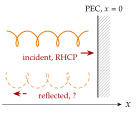
The reflected wave travels towards with , and its amplitude is fixed by the condition at . The hand of each wave is judged against its own .
. At , : a circle of radius , from to , about . Right hand: RHCP.
It travels towards , . Both and are tangential to the plane , so gives :
At , turns the same way in time, from to , about . But now : the reflected wave is LHCP.
, so
It is a standing wave: no dependence remains. It vanishes at all times where , that is on the planes ,
At the total field is zero at every instant, as the boundary condition demands.
At every point the total field still rotates in a circle, of radius , but nothing travels: the time-average Poynting vectors of the incident and the reflected wave cancel. The reversal of the hand on reflection is why an RHCP GPS antenna rejects single-bounce echoes (Application 6.1.2), and why a circularly polarised radar does not see a large flat plate with its own transmitting antenna unless the receiver uses the opposite hand. Reflection at a boundary is the subject of Section 6.3.