Section 6.1 · Home exercises · 6 of 8
Home exercise 6.1.6: Doppler on a high-speed train
Doppler on a high-speed train
#A train runs at on a straight track. A base station transmitting at stands from the track. Let be the distance, measured along the track, from the train to the point of the track closest to the station ( before passing).
- Show that the receiver on the train sees (moving observer).
- Evaluate the shift at , , , and .
- How large is the total frequency swing, and in about how long does most of it happen?
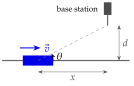
The train is a moving observer: by Eq. (6.1.70), where is the angle between its velocity and the line from the train to the station. Only the geometry of is new.
The line from the train to the station has the components along the track (in the direction of motion while ) and across it, so and
and :
| (m) | (Hz) |
|---|---|
Far away the shift tends to , so the total swing is . Most of it happens while , that is in about .
Type , , , and below and compare the shift with the table.
At , and the shift is . The curve is odd in , as the symmetry of the pass requires.
A jump of more than a kilohertz within about a second is a real problem for an LTE or 5G receiver, whose subcarriers are apart: the shift is a sizeable fraction of the spacing and must be tracked by the receiver.