Section 6.2 · Topic 7 of 9
6.2.7 Group velocity
Dispersion
The phase velocity is related to the phase constant by . In a lossless dielectric and the phase velocity is a constant. In some media, however, is not a linear function of , and different frequencies travel with different velocities: the plasma, Eq. (6.2.40), and the good conductor, Eq. (6.2.25), are two examples. A signal that carries information always occupies a band of frequencies. If its component frequencies travel with different velocities, the signal is distorted as it travels. This phenomenon is called dispersion, and a medium in which it occurs is a dispersive medium.
The behaviour of a medium is best displayed in the dispersion diagram, against (Figure 6.2.14). A lossless dielectric is a straight line through the origin. In a plasma, is a hyperbola that starts at the cutoff and approaches the light line . The phase velocity at an operating point is the slope of the secant from the origin, . The slope of the tangent, , is the group velocity defined below.
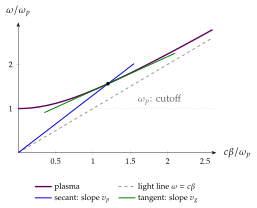
The wave packet
An electromagnetic wave carrying information usually consists of a small spread of frequencies, the side bands, loaded on a high carrier frequency. Together they form a wave packet, a group of frequencies, and the velocity of this group is called the group velocity. The simplest packet is made of two waves of equal amplitude at the angular frequencies , with the phase constants and . With ,
A point of constant carrier phase, const., moves with . A point of constant envelope phase, const., moves with , and in the limit this becomes a derivative.
The crests of the carrier move with , the envelope that carries the message moves with . They are equal only when is proportional to .

Group velocity in a plasma
For a plasma, , so
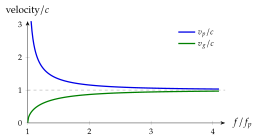
In a plasma the crests run faster than light and the envelope slower, by the same factor, and the product of the two speeds is always .
It seems that the phase velocity exceeds the speed of light, but this does not violate special relativity. A single-frequency plane wave is an idealisation: it has no beginning and no end and carries no message. Real signals are sums of many frequencies travelling as a group, and once single-frequency plane waves are understood, the group of them that carries the information can be understood too. Energy and information travel with , and in the plasma always (Figure 6.2.16). Near the cutoff and a pulse crawls. An HF pulse crossing the ionosphere is therefore delayed (the group delay of Problem 6.2.3), while its carrier phase advances. Dual-frequency GPS receivers remove the resulting range error through its dependence (Exercise 6.2.8).
Move below towards and watch the envelope fall behind while the crests race ahead. The layer is that of Problem 6.2.3, thick with , crossed by two tones either side of .
Concluding from that something travels faster than light, or that breaks relativity. Nothing physical moves with a crest: in a packet the crests are born at its back, run through it and die at its front (Problem 6.2.3). Energy and information move with the envelope, at .
In a plasma at some frequency. What is , and what is ?
. From , and , exactly the layer of Problem 6.2.3.
A good conductor is dispersive too. There grows only as , and Home exercise 6.2.3 shows that : the group is faster than the phase. A medium with , such as the plasma, is called normally dispersive, one with anomalously dispersive.
Table 6.2.3. The applications of this section.
| Application | Physics used | Worked out in |
|---|---|---|
| Talking to a submarine | , , dB | Problems 6.2.1, 6.2.4, Worked example 6.2.2 |
| Ionospheric HF skywave | , | Problems 6.2.2, 6.2.3, Home exercise 6.2.2 |