Section 6.2 · Further exercises · 11 of 13
Exercise 6.2.11: How much does a phone heat the head?
About the further exercises of Section 6.2
Thirteen further exercises in the spirit of the problems, the worked examples and the home exercises, graded from easy to harder within each group. Exercises 6.2.1–6.2.3 are about lossy media and the loss tangent, Exercises 6.2.4–6.2.5 about good conductors and the skin effect, Exercises 6.2.6–6.2.8 about plasmas and the group velocity, and Exercises 6.2.9–6.2.13 come from the exercise lecture and mix all three. They use only the equations listed at the head of this subsection, together with and , .
How much does a phone heat the head?
#The tissue of Problem 6.2.7 (: , , , take the density ) receives a plane wave whose transmitted power density just inside the surface is . The specific absorption rate is (W/kg). (a) Find the amplitude of at the surface. (b) Find the SAR at the surface and check it against . (c) At which depth is the SAR halved? What is it at ? (d) Find the average SAR over the first centimetre. (e) Which would bring that average to the limits (FCC) and (ICNIRP)?
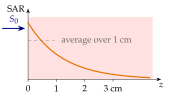
Just inside the surface the transmitted wave is with . The SAR follows the loss density .
.
. Power balance: gives at , that is .
The SAR is halved at . Over the power factor is (the amplitude ratio of Problem 6.2.7, squared), so .
The power absorbed in the first centimetre per square metre is , and the mass is :
The average is proportional to : for and for .
The two routes in (b) agree because gives , and . The SAR limits are averaged over g (FCC, a cube of side) or g (ICNIRP) of tissue, so (d) is the right kind of number to compare. A phone is not a plane-wave source: its near field concentrates on a few square centimetres, which is why SAR is measured in a head phantom filled with liquid of exactly the parameters of Problem 6.2.7 rather than computed.
cf. Problem 6.2.7