Section 6.2 · Further exercises · 12 of 13
Exercise 6.2.12: Why sodium is transparent to ultraviolet
About the further exercises of Section 6.2
Thirteen further exercises in the spirit of the problems, the worked examples and the home exercises, graded from easy to harder within each group. Exercises 6.2.1–6.2.3 are about lossy media and the loss tangent, Exercises 6.2.4–6.2.5 about good conductors and the skin effect, Exercises 6.2.6–6.2.8 about plasmas and the group velocity, and Exercises 6.2.9–6.2.13 come from the exercise lecture and mix all three. They use only the equations listed at the head of this subsection, together with and , .
Why sodium is transparent to ultraviolet
#The conduction electrons of a metal form a plasma. Sodium has the density and the atomic mass , and gives one free electron per atom (). Neglect collisions. (a) Find the electron density , the plasma frequency and the corresponding free-space wavelength . (b) Green light () falls on sodium. Find , the attenuation constant, the depth , and the thickness of a film that reduces the field by . What is , and what does it say about the power entering the metal? (c) For ultraviolet light of find , the refractive index, the wavelength in the metal, , and .
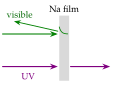
Below the plasma permittivity is negative and the wave is evanescent: is real and purely reactive. Above it propagates with , like the ionosphere above its critical frequency, only with larger by about .
,
, and . Then is real:
With the root that makes the field decay into the metal, as in Eq. (6.2.41),
It is purely imaginary, so and are in quadrature and . No power enters a thick metal: the light is totally reflected, which is the metallic lustre.
: and , so
. In (b), and . The other root of , , would give and a field growing into the metal: the sign of the reactance follows from the direction of decay. R. W. Wood found in 1933 that thin films of the alkali metals become transparent in the ultraviolet, sodium near , in remarkable agreement with this free-electron estimate. For copper, silver and gold the bound d-electrons add to the permittivity and shift the edge into the visible or near ultraviolet, which gives copper and gold their colours.
cf. Problem 6.2.2