Section 6.2 · Further exercises · 13 of 13
Exercise 6.2.13: Why medium-wave stations travel far only at night
About the further exercises of Section 6.2
Thirteen further exercises in the spirit of the problems, the worked examples and the home exercises, graded from easy to harder within each group. Exercises 6.2.1–6.2.3 are about lossy media and the loss tangent, Exercises 6.2.4–6.2.5 about good conductors and the skin effect, Exercises 6.2.6–6.2.8 about plasmas and the group velocity, and Exercises 6.2.9–6.2.13 come from the exercise lecture and mix all three. They use only the equations listed at the head of this subsection, together with and , .
Why medium-wave stations travel far only at night
#In daylight the lowest region of the ionosphere, the D layer (heights of about to ), holds about free electrons per , and at that height an electron collides with neutral molecules about times per second. (a) Add the friction force to the equation of motion, , and show that the layer is a lossy dielectric with
(b) Find . At (medium-wave broadcasting) and at (short wave) find , and the loss tangent, and show that . (c) A sky wave crosses the thick layer twice, up and down (take vertical incidence). Find the absorption in dB at both frequencies. (d) Below which frequency does it exceed ? (e) At night the D layer almost disappears: take . What is the absorption at then?
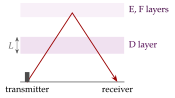
In phasor form the friction turns the electron current into a complex conductivity. Its real part is an ordinary conductivity that absorbs the wave, its imaginary part lowers the permittivity as in the collisionless plasma. For the loss tangent is small and the low-loss formula applies.
With , , so and the current density is . In Ampère's law,
with . The bracket is , which gives the two expressions of the statement. For they reduce to the lossless plasma of Eq. (6.2.38).
, .
Both loss tangents are small. With and ,
and the table gives the exact values (at the factor adds ).
: at , at .
, and for , rad/s: .
: a hundred times fewer electrons give a hundred times less absorption, at .
The exact at is , and its is , as it should be for a low-loss medium. For the absorption falls as : , close to the exact . This is why medium-wave (AM) stations are heard only by their ground wave in daytime, but a thousand kilometres away at night, when the D layer has gone and the sky wave returns from the E and F layers above it. Short-wave services move up in frequency by day to escape the D-layer absorption and down at night, because the F layer then cannot return the higher frequencies (Application 6.2.2). At oblique incidence the path through the layer is longer by , and so is the absorption in dB.
cf. Home exercise 6.2.2