Section 6.2 · Further exercises · 4 of 13
Exercise 6.2.4: Induction hardening of a steel shaft
About the further exercises of Section 6.2
Thirteen further exercises in the spirit of the problems, the worked examples and the home exercises, graded from easy to harder within each group. Exercises 6.2.1–6.2.3 are about lossy media and the loss tangent, Exercises 6.2.4–6.2.5 about good conductors and the skin effect, Exercises 6.2.6–6.2.8 about plasmas and the group velocity, and Exercises 6.2.9–6.2.13 come from the exercise lecture and mix all three. They use only the equations listed at the head of this subsection, together with and , .
Induction hardening of a steel shaft
#A steel shaft is surface-hardened by an induction coil. Below the Curie temperature (about ) the steel has and , above it and . (a) Find the skin depth in cold and in hot steel at . (b) Which frequency gives in the hot steel, and what is of the cold steel at that frequency? (c) Find both skin depths at and comment.
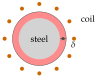
: both the permeability and the conductivity change at the Curie point, and the product falls by a factor of .
From ,
At , and . A hot shaft of a few centimetres is heated right through: mains frequency cannot harden a thin surface layer.
At , : steel is an excellent conductor and the skin-depth formula holds. Cold, the high confines the heating to a few tens of micrometres. Once the surface passes the Curie point, collapses and the heat source moves times deeper. Hardening machines are therefore designed with the hot skin depth, which is why to is typical for millimetre case depths.
cf. Problem 6.2.4