Section 6.2 · Further exercises · 5 of 13
Exercise 6.2.5: Loss in a copper wall
About the further exercises of Section 6.2
Thirteen further exercises in the spirit of the problems, the worked examples and the home exercises, graded from easy to harder within each group. Exercises 6.2.1–6.2.3 are about lossy media and the loss tangent, Exercises 6.2.4–6.2.5 about good conductors and the skin effect, Exercises 6.2.6–6.2.8 about plasmas and the group velocity, and Exercises 6.2.9–6.2.13 come from the exercise lecture and mix all three. They use only the equations listed at the head of this subsection, together with and , .
Loss in a copper wall
#At the inner surface of a thick copper wall () at , the magnetic field is tangential with amplitude , and the wave enters the copper along the normal : . (a) Find , , and the tangential at the surface. (b) Find the time-average power entering one square metre. (c) Check (b) by integrating the Joule loss over the depth. (d) Show that the total current per unit width flowing in the wall equals , so that the loss is . (e) Repeat (b) for brass, .
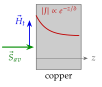
In a good conductor with , so everything follows from . The power entering the wall must equal the Joule heat inside it, and the current in it must account for the jump of from to zero.
, , with , so .
with :
, so
the same as (b), since .
, and per unit width
so the loss is : is truly the resistance per square of the wall.
Brass: , , loss , times that of copper.
This is the recipe for the wall loss of every waveguide and cavity of Chapter 7: find the tangential of the ideal, lossless field at the walls and integrate over them. Silver or copper plating a few skin depths thick halves the loss of a brass guide.
cf. Worked example 6.2.2