Section 6.2 · Further exercises · 6 of 13
Exercise 6.2.6: The plasma in a fluorescent tube
About the further exercises of Section 6.2
Thirteen further exercises in the spirit of the problems, the worked examples and the home exercises, graded from easy to harder within each group. Exercises 6.2.1–6.2.3 are about lossy media and the loss tangent, Exercises 6.2.4–6.2.5 about good conductors and the skin effect, Exercises 6.2.6–6.2.8 about plasmas and the group velocity, and Exercises 6.2.9–6.2.13 come from the exercise lecture and mix all three. They use only the equations listed at the head of this subsection, together with and , .
The plasma in a fluorescent tube
#The discharge in a fluorescent tube contains about free electrons per (collisions neglected). (a) Find . (b) A Wi-Fi wave meets the plasma: find in Np/m and dB/m, and estimate the attenuation across a tube of diameter treated as a slab. (c) For find , , , , and . (d) Which electron density would block as well?
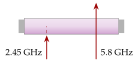
Compare with . Below it the wave is evanescent, Eq. (6.2.39), above it the plasma formulas Eq. (6.2.38) and Eq. (6.2.51) apply.
.
, evanescent:
about across the tube, and the wave is mostly reflected, not absorbed.
:
requires .
. Switching the discharge on and off turns the tube from a reflector into a transparent window for frequencies near : the principle of the "plasma antenna" and of reconfigurable plasma shields. Real discharges are collisional, so part of the power is absorbed rather than reflected.
cf. Problem 6.2.2