Section 6.2 · Further exercises · 7 of 13
Exercise 6.2.7: A microwave interferometer
About the further exercises of Section 6.2
Thirteen further exercises in the spirit of the problems, the worked examples and the home exercises, graded from easy to harder within each group. Exercises 6.2.1–6.2.3 are about lossy media and the loss tangent, Exercises 6.2.4–6.2.5 about good conductors and the skin effect, Exercises 6.2.6–6.2.8 about plasmas and the group velocity, and Exercises 6.2.9–6.2.13 come from the exercise lecture and mix all three. They use only the equations listed at the head of this subsection, together with and , .
A microwave interferometer
#A beam crosses a uniform plasma slab of thickness . Compared with an identical path in vacuum, the transmitted wave shows a phase lead of . (a) Find the electron density exactly. (b) For show that , so that is proportional to , and compare. (c) What is the largest density this instrument can measure? (d) Why is the phase a lead?
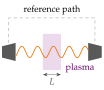
In the plasma , so the wave accumulates less phase than in vacuum. The phase difference over the slab is .
and rad. The lead means :
, so , and with the phase is linear in . Here , that is , high.
Beyond the beam is reflected: (in practice a few times less, to keep the beam from bending).
in the plasma: the crests run ahead of those of the vacuum path.
Interferometry measures the line integral without touching the plasma, which is why it is a standard diagnostic of fusion experiments and plasma reactors. The phase leads, while a pulse sent along the same path would arrive late: the next exercise uses exactly this pair.
cf. Problem 6.2.3