Section 6.2 · Problems · 1 of 8
Problem 6.2.1: Seawater at 1 MHz and at 30 GHz
Seawater at 1 MHz and at 30 GHz
#Analyse seawater (, , ) for the frequencies and : classify it at each frequency with , then find , , , , and the skin depth with the appropriate approximate formulas, and check them against the exact ones.
Adapted from: S. J. Orfanidis, Electromagnetic Waves and Antennas, Example 2.7.1.
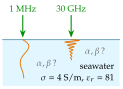
The loss tangent decides which approximation is allowed. Compute it first, use the matching short formulas, then confirm with the exact .
With and , :
At seawater is a good conductor, at a low-loss dielectric.
With ,
At the exact formulas give , , , and at , , . Both approximations are good to better than .
Drag below from to and see seawater move from a good conductor () to a low-loss dielectric ().
At the angle of is and , as for any good conductor. At , the low-loss relation . "Low-loss" is per wavelength: at the field loses only () per wavelength, but that is . At , the "good conductor", the loss is , twenty times less.
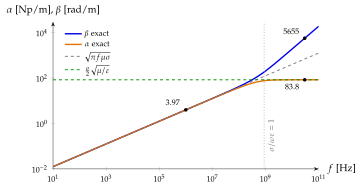
Figure 6.2.17 joins the two answers. Real water is a polar dielectric, though: its falls and its rises above a few gigahertz (a relaxation near ), so the numbers are those of the model medium, and the true attenuation is larger still.