Section 6.2 · Problems · 2 of 8
Problem 6.2.2: The re-entry blackout
The re-entry blackout
#When a spacecraft reenters the earth's atmosphere, its speed and temperature ionize the surrounding atoms and molecules, creating a plasma. It has been estimated that the electron density is in the neighborhood of . Discuss the plasma's effect on frequency usage in radio communication between the spacecraft and the mission controllers on earth. In particular, find (b) the attenuation of a signal in dB/m and (c) , and at .
Adapted from: D. K. Cheng, Field and Wave Electromagnetics, 2nd ed., Example 8-5.
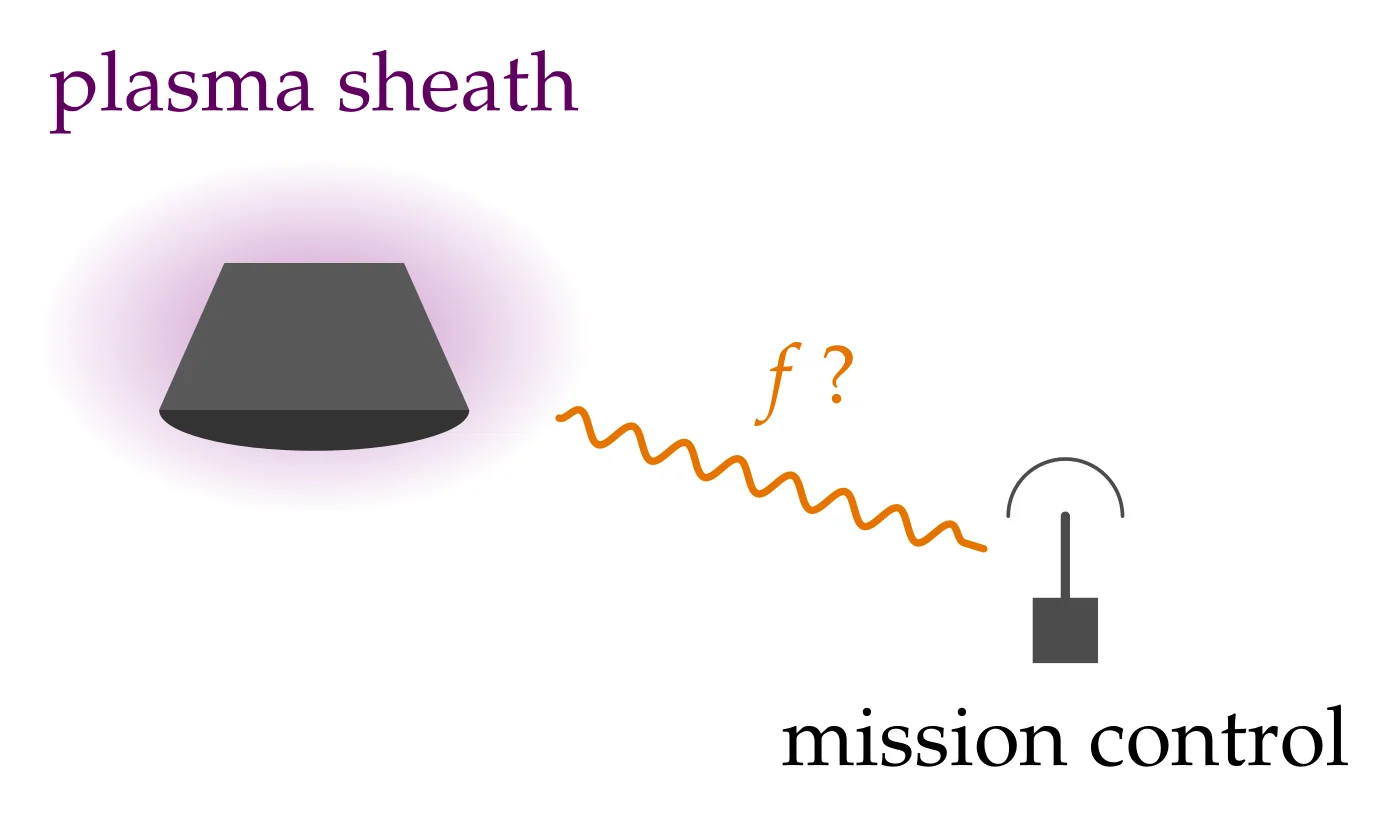
Find the plasma frequency. Below it is real (evanescent field, total reflection), above it (propagation without loss, , ).
, so
Radio communication must use frequencies well above .
and
The impedance is purely reactive, so : no power enters the sheath, and the signal is reflected by it.
:
Raise below past and the evanescent field turns into a propagating wave.
. As , (), the largest attenuation the sheath can give (Figure 6.2.18).
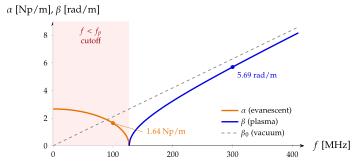
Below the link is cut: this is the radio blackout of re-entry, several minutes long for the Apollo capsules. At S band () and this sheath is practically transparent. The engineering responses are to use frequencies far above the worst-case , to put the antennas where the sheath is thin (the aft body), or to reduce locally by injecting liquids into the flow, as was tested in the 1960s. The Space Shuttle shortened its blackout by relaying through satellites above it.