Section 6.2 · Problems · 3 of 8
Problem 6.2.3: Group delay through an ionospheric layer
Group delay through an ionospheric layer
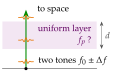
#An HF signal consists of two tones of equal amplitude at , with and . It crosses vertically an ionospheric layer of thickness and uniform electron density (collisions neglected).
- Find the plasma frequency of the layer.
- Find and at and check that .
- How much later than in vacuum does the envelope leave the layer?
- Find the carrier wavelength in the layer and the distance between successive maxima of the envelope.
The carrier crests travel with , the envelope of the two-tone packet with . In a plasma both follow from the one factor , Eq. (6.2.51).
.
, so and
The envelope crosses the layer with , in
so the excess group delay is .
The carrier wavelength is , against in vacuum: longer in the plasma. The envelope of Eq. (6.2.48) repeats when grows by , and :
gives and , so and .
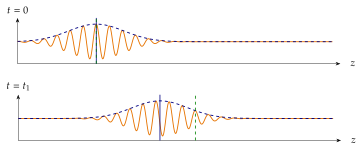
The information arrives late () while the carrier phase runs ahead (), by the same factor . Figure 6.2.19 shows what this means for a packet: crests are born at its back, run through it and die at its front. Energy sits where the envelope is, so it moves with . Nothing physical travels with a crest, so breaks no law. An ionosonde measures exactly this group delay, and GPS corrects it: at the effect is tiny, but it is still metres of range error (Exercise 6.2.8).