Section 6.2 · Problems · 4 of 8
Problem 6.2.4: How thick must a shield be?
How thick must a shield be?
#An equipment enclosure is made of aluminium (, ). Considering only the attenuation of the wave inside the wall (absorption loss, neglect the reflections at its surfaces):
- Find , , , and of aluminium at .
- Find the minimum wall thickness that reduces the field amplitude by at .
- Repeat (b) at the power frequency , and comment.
Adapted from: S. J. Orfanidis, Electromagnetic Waves and Antennas, Problem 2.20.
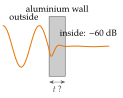
Check that aluminium is a good conductor. Then the field decays as , which is per skin depth. A required attenuation fixes , and does the rest.
, so
A reduction of is a factor in amplitude:
grows by : and .
An aluminium wall is absurd. At power frequencies the magnetic field is shielded with a high-permeability alloy instead. Mu-metal, with and , has
Set below to and read how thick the aluminium wall must be for : , against at .
skin depths give . At the same rule gives : every factor in frequency divides , and the thickness needed, by (Figure 6.2.20).
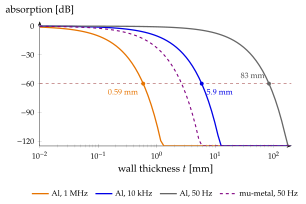
At radio frequencies a thin metal sheet is an excellent shield, and the reflection at the surface between air and metal (, Section 6.3) adds another large loss. The weak spots of a shield are its seams, slots and cable entries. At conductivity alone is not enough: permeability is needed.