Section 7.1 · Topic 7 of 10
7.1.7 Wave impedances ZTM and ZTE
For a plane wave the ratio of the transverse fields is the intrinsic impedance . In a guide the corresponding ratio is the wave impedance of the mode.
TM (). From Eq. (7.1.11), and , while and . The derivatives cancel in the ratios:
since .
TE (). Now , , and similarly for , :
since .
and in every case .
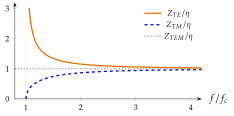
The transverse fields of a guided mode are related exactly as for a plane wave travelling along , with replaced by . TM modes have , TE modes , and for two modes with the same cutoff.
Below cutoff , and the impedances become imaginary:
A purely reactive puts and in quadrature, so that : an evanescent mode stores energy near its source but carries no power.
Thinking that a mode below cutoff is absorbed. Nothing is dissipated in a lossless guide: the reactive wave impedance means that the evanescent field returns its energy to the source every cycle, and the incident power is reflected. This is why a waveguide below cutoff works as a reflecting attenuator and as a screen (Exercise 7.1.3).
At some frequency a TM mode has . What is the wave impedance of a TE mode with the same cutoff, at the same frequency?
The two share , so . Check: .