Section 7.1 · Further exercises · 3 of 5
Exercise 7.1.3: A honeycomb air vent in a shielded room
About the further exercises of Section 7.1
Five further exercises on the general analysis of uniform guides, graded from easy to harder. None of them needs the shape of the cross-section: (or a measurement) is all that is known.
A honeycomb air vent in a shielded room
#A shielded room needs ventilation. The opening is covered by a honeycomb panel: an array of metal tubes, each long, whose lowest mode has the cutoff frequency (Sections 7.3 and 7.4 show how follows from the cell size). Treat the field that enters a cell as this mode.
- Find the attenuation of one cell, in dB, at and at .
- How long must the cells be for at ?
- Above which frequency does a cell give less than ?
- Where does the blocked power go?
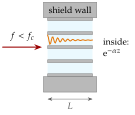
Below cutoff the mode decays as with and (air). The attenuation of a length is dB. Far below cutoff , independent of frequency.
.
.
in needs , so and : less than above , and above the cell is an open pipe.
Below cutoff or is purely reactive, so the cell carries no time-average power. The wall and the cells together reflect the incident wave, and only the exponentially small field at the far end leaks out. Nothing is absorbed.
Far below cutoff the rule gives at , within of the exact value.
The vent works like a sieve with holes far smaller than the wavelength. Its shielding is set by the length-to-width ratio of the cells, roughly to for every cell width of length at low frequency (square or round cells, compare Home exercise 7.2.3 in Section 7.2). A panel has many cells whose leakage adds, and a cable or wire pushed through a cell turns it into a coaxial line with a TEM mode and no cutoff, which ruins the shielding completely.
cf. cutoff