Section 7.1 · Further exercises · 4 of 5
Exercise 7.1.4: Two modes, two arrivals
About the further exercises of Section 7.1
Five further exercises on the general analysis of uniform guides, graded from easy to harder. None of them needs the shape of the cross-section: (or a measurement) is all that is known.
Two modes, two arrivals
#An oversized air-filled metal guide, long, supports two propagating modes at , with cutoffs and . The next mode has its cutoff at . A short pulse at excites both modes at the input.
- Find , and of each mode.
- Find the arrival times of the two pulses and their separation.
- What is the highest pulse rate at which pulses of different modes do not overlap?
- To which carrier frequency must the system move to bring the separation down to ? Is that allowed?
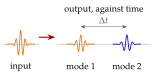
Each mode carries its own copy of the pulse at its own group velocity . The copies leave together and arrive apart: intermodal dispersion, which needs no bandwidth at all.
, . , :
and : the two copies arrive apart (free space would take ).
Successive pulses must be at least apart, a rate of at most million pulses per second, however short each pulse is.
requires . Solving numerically, (, ). That is below the cutoff of the third mode, so the guide still carries only two modes.
At :
Raising the frequency moves both modes towards the light line, where all group velocities approach and the spread shrinks, but more modes appear. Long waveguide runs are therefore built single-mode, and a multimode guide (like a multimode optical fibre, Section 7.6) limits the data rate in proportion to .
cf. group velocity