Section 7.1 · Further exercises · 5 of 5
Exercise 7.1.5: Dielectric loss of any guided mode
About the further exercises of Section 7.1
Five further exercises on the general analysis of uniform guides, graded from easy to harder. None of them needs the shape of the cross-section: (or a measurement) is all that is known.
Dielectric loss of any guided mode
#A guide of arbitrary cross-section is filled with a slightly lossy dielectric, , , and its walls are perfect.
- Show that above cutoff, for every TE or TM mode, , which is the TEM value divided by ( is the lossless wavenumber).
- PTFE filling, , , a mode with : find at and compare with a TEM wave in the same dielectric.
- The formula diverges at . Find the exact there.
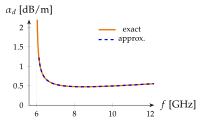
- At which frequency is smallest?
The boundary conditions fix through the geometry alone, so does not change when the filling becomes lossy. Only becomes complex, and is expanded for small .
With ,
With : , the TEM value divided by . Since , this is also , the dielectric attenuation, Eq. (7.2.36) in Section 7.2.
, , :
against for a TEM wave at in PTFE.
At , and , so and
( at ), finite, with an equal phase constant .
. Setting the derivative of its square, , to zero gives : the minimum is at , where .
The exact value at , computed without approximation, is , the same to four figures. The approximation is still within at () and within at , and fails only in the last few per mille above cutoff, as the graph shows.
Near cutoff the zig-zag waves of Section 7.2 bounce almost straight across the guide and spend a long time in the dielectric for every metre of progress, which is the . Below cutoff the exact joins smoothly onto the evanescent value , so in a lossy guide the "cutoff" is not perfectly sharp.
cf. cutoff