Section 7.8 · Topic 1 of 18
7.8.1 Why a box?
A resonator stores energy that alternates between an electric and a magnetic form. At low frequencies a coil and a capacitor do this. Above about they stop working well: the inductance and the capacitance needed become tiny, the leads add parasitic and of the same size, the part radiates because its size is no longer small compared with the wavelength, and the current crowds into a skin a micrometre thick (Section 6.2), so the resistance and the loss grow. Metal walls all around solve every one of these problems at once. The field is kept inside and cannot radiate, and the current that the field induces on the walls spreads over large areas, so the loss stays small. A cavity resonator therefore behaves like a parallel circuit with a very high quality factor ( to for copper walls, against about for a lumped circuit), and it is used in oscillators, filters and frequency references.
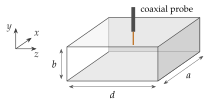
Figure 7.8.1 shows the basic object, a rectangular box with sides , , along , , , fed by a coaxial probe through the centre of its top wall. Inside it, the guided waves of Section 7.3 bounce between the end walls, and only standing waves at discrete resonant frequencies survive. We now make this precise.