Section 7.8 · Topic 5 of 18
7.8.5 Mode indices, degeneracy and the dominant mode
The allowed indices of the two families are collected in Table 7.8.1.
Table 7.8.1. Allowed mode indices of the rectangular cavity. For TE modes and may not both be zero ().
| Mode | |||
|---|---|---|---|
| TM | |||
| TE |
Two modes are degenerate when they have different field patterns but the same resonant frequency. In a rectangular cavity TE and TM are always degenerate when , since Eq. (7.8.8) does not depend on the family. Equal sides, or sides in simple ratios, add more degeneracies.
The dominant mode is the mode with the lowest resonant frequency. The candidates are the three modes with two indices equal to one and the third equal to zero, TM, TE and TE, whose frequencies omit , or respectively. Since a larger side means a lower frequency, the mode that omits the smallest side wins:
- : TE, with ,
- : TM, and for a cube () all three together.
The smallest side never enters the dominant resonance. It stays free, and in the usual case it is the height .
Figure 7.8.4 is the mode chart of the cavity of Problem 7.8.1. Each bar starts at a resonant frequency (orange for TE, blue for TM, both colours for a degenerate TE/TM pair). Unlike a guide, a cavity does not pass a band of frequencies above a cutoff: it responds only near these discrete frequencies. The dominant TE lies below the next resonance.
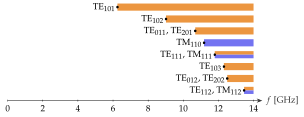
Click the lines of the mode chart below to see each mode's pattern, and shrink to see which resonances move: only those with do.
A cavity has , , . Which is its dominant mode?
The smallest side is , so the dominant mode is the one that omits : TM (), with in air. The TE modes need and all contain the large term .