Section 7.8 · Topic 8 of 18
7.8.8 The quality factor
Real walls conduct imperfectly, a real filling absorbs a little, and every coupling lets some energy out. A cavity therefore loses energy, and how fast it does so compared with the energy it stores is measured by one number.
The quality factor of a resonator is
where is the time-average stored energy, the time-average power lost and the resonant angular frequency. (The energy lost in one period is , which gives the second form.)
Free decay
Left alone after the source is switched off, the cavity loses its energy at the rate . Hence
The energy falls to in , that is after periods. The field, whose square is the energy, decays half as fast.
Driven response
Driven by a source near resonance the cavity responds like a parallel circuit (see the box below), with the normalised response
Its magnitude falls to , the response power to one half, where .
The half-power (3 dB) bandwidth of a resonator is
The relation is exact for the model and very accurate whenever .
A high means three things at once: the cavity stores many cycles' worth of energy, it rings for a long time after the drive stops, and it responds only in a narrow band around . Cavities with copper walls reach to , superconducting cavities , while a lumped circuit stops near .
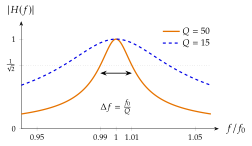
A parallel circuit driven by a current has the admittance with and . At resonance it stores () and loses , so : the of the circuit is the of definition Eq. (7.8.18). The normalised voltage response is , and near resonance , which gives Eq. (7.8.20). The half-power points satisfy with , whose positive roots differ by exactly . Exercise 7.8.6 builds the equivalent circuit of a real cavity.