Section 7.8 · Topic 9 of 18
7.8.9 Q of the TE₁₀₁ mode with conducting walls
Walls of conductivity and permeability have the surface resistance
where is the skin depth (Sections 6.2 and 7.3). A tangential magnetic field at the wall drives the surface current , which dissipates per unit area. As for the attenuation of a guide, we compute this loss with the fields of the lossless cavity, which barely change when is a micrometre.
For the TE mode Eq. (7.8.12) the six walls come in three pairs:
- the end walls (each ) carry , with , and contribute to the bracket below,
- the side walls (each ) carry and contribute ,
- the top and bottom walls (each ) carry both and , and with Eq. (7.8.13) they contribute .
Adding the three pairs,
With from Eq. (7.8.17), , , and , from Eq. (7.8.13), the dimensions collect into one formula.
For a cube () it reduces to
the size of the cavity over the skin depth, times one third.
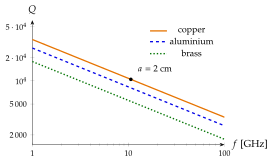
compares the volume where the energy is stored with the thin skin where it is lost. A cavity a few centimetres across with a skin depth below a micrometre has of order ten thousand.
A copper cube with resonates at , where , and . Figure 7.8.8 shows how this changes with the size. Scaling the cube down raises and lowers less quickly, so : small, high-frequency cavities have lower .
- Fields. Write the lossless fields of the mode with one amplitude, or .
- Energy. (at resonance , so either may be doubled).
- Loss. On each wall take the tangential and integrate over the wall. Add all the walls, then the dielectric loss if the filling absorbs.
- Ratio. . The amplitude cancels, and the result depends only on the geometry, the frequency and .
All dimensions of a copper cubic cavity are doubled. How do its TE resonant frequency and its change?
The frequency halves. The skin depth grows by , and grows by . Exercise 7.8.3 uses the same scaling.