Section 7.8 · Topic 10 of 18
7.8.10 Loaded Q, coupling and bandwidth
A cavity loses energy through several channels: the walls (conductor loss), the filling (dielectric loss) and the couplings to the outside world, through which the power leaves to the source and the load. Each channel adds its own power to , and since , the reciprocal values add:
The unloaded describes the cavity itself (walls and filling), the power that leaves through the couplings, and the loaded the whole. The result holds for a cavity completely filled with a dielectric of loss tangent : the dielectric dissipates , and .
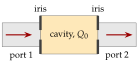
The strength of a coupling is measured by the coupling coefficient of each port, the ratio of the power that leaves through the port to the power lost inside. At the cavity looks to the line like a shunt conductance of normalised value . For a symmetric transmission cavity with two ports (Figure 7.8.9a) the line at port 1 sees in parallel with the matched port 2, the normalised admittance , so that and the transmitted wave is (the shunt element leaves the voltage continuous).
A one-port cavity has and . It is matched at critical coupling, , where .
Couple strongly and most of the power passes through, but the band is wide (low ). Couple weakly and the band is narrow, but most of the power that enters is lost in the walls. A narrow, low-loss filter therefore needs a resonator with a high .
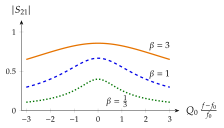
Taking the measured half-power width as . A measured resonance curve always includes the loading by the ports, so is the loaded . Only with very weak couplings () does it approach . Otherwise must be recovered from and the coupling, for example from the peak transmission with Eq. (7.8.27) (Problem 7.8.4) or from the reflection of a one-port cavity (Exercise 7.8.5).
A one-port cavity with is critically coupled. What bandwidth does one measure at , and how much of the incident power is reflected at ?
gives and . : nothing is reflected, all the incident power is absorbed in the walls.
A MULTIMODE CAVITY
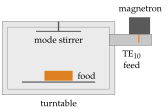
A domestic microwave oven is a metal box of about fed by a magnetron through a short TE guide (Section 7.3 and Figure 7.8.10a). The perforated metal sheet in the door is part of the wall: its holes are much smaller than the wavelength and the field does not leak through them. At () the box is several wavelengths wide in every direction. Its lowest resonance (TE) is at only , and near the resonances crowd together, about apart. A large cavity has a dense spectrum, and the number of modes in a band (both polarisations) is estimated by the mode-counting formula
where . It counts the integer triples inside a thin shell of an ellipsoid in index space, two modes per triple.

| Quantity | Value |
|---|---|
| Resonances in to | (estimate ) |
| Mean spacing | |
| Loaded with food | , so |
| Hot-spot spacing (TE) | , |
| Empty oven ( of steel walls) | thousands |
- The food, wet and very lossy, lowers to about . The bandwidth then spans several resonances, and several modes are driven together, each with its own hot spots (Figure 7.8.10b shows one of them). Their spacing is never less than , since each of the three components of the wave vector is at most .
- The turntable carries the food through the pattern, and the mode stirrer, a rotating metal fan, shifts the resonances in time so that the pattern itself moves. Both even out the heating.
- Never run an oven empty. Its is then high, little power is absorbed, and most of it returns to the magnetron (Home exercise 7.8.4 shows how a circulator protects it). Worked example 7.8.1 puts numbers in.
With below, several resonances respond to the magnetron at once. Count the hot spots of TE.