Section 7.8 · Topic 11 of 18
7.8.11 The circular cylindrical cavity
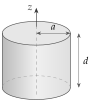
Close a circular guide of radius (Section 7.4) by conducting plates at and (Figure 7.8.11). The rule of Section 7.8.2 applies unchanged and gives standing waves with . The cutoff wavenumbers of the circular guide are for TM modes, with the -th zero of the Bessel function , and for TE modes, with the -th zero of its derivative . With :
with , and , , .
The physics is that of the rectangular box: counts the periods around , the order of the zero across , and the half guide wavelengths along . Only the transverse numbers come from Bessel functions instead of sines.
In air it is handy to write , so that a Bessel zero divided by the radius in centimetres gives the frequency in GHz directly. The lowest resonance is TM, with , as long as the cavity is not too long. Since TE has the smaller transverse number () but needs , it overtakes TM when , that is at
The dominant mode is TM for and TE for longer cavities.