Section 7.8 · Further exercises · 3 of 10
Exercise 7.8.3: A copper filter on a hot day
About the further exercises of Section 7.8
Ten further exercises in the spirit of Problems 7.8.1–7.8.5 and the home exercises, graded from easy to harder. Exercises 7.8.1–7.8.6 are about cavity resonators, Exercises 7.8.7–7.8.10 about microwave devices and scattering parameters. They use only the results of this section, in particular , of Eq. (7.8.24) with ( for a cube), of Eq. (7.8.33), , , , the response with , and for S-parameters , reciprocity , losslessness , and .
A copper filter on a hot day
#A single-cavity bandpass filter is a copper cube resonating in the TE mode at , with loaded . Copper expands by per kelvin. (a) Find the side, and the bandwidth. (b) The filter warms by . By how much does move, and how much does the transmission at fall? (c) Repeat for a filter of invar (, silver-plated so that is unchanged). What temperature change does each tolerate for of extra loss? (d) The same design is scaled up three times for . What is its ?
Adapted from: D. K. Cheng, Field and Wave Electromagnetics, 2nd ed., Example 10-16.
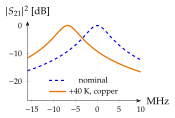
Uniform expansion scales every dimension by , and every resonant frequency is inversely proportional to the size: , for any mode and any shape. The filter response is .
gives . Then and . The band is .
, more than the whole bandwidth. At the filter is now detuned by , :
Invar: , , extra loss . For , , that is :
At three times the size falls to and grows by , so grows by : .
Directly, a cube of at has and . The loaded is set by the couplings, which scale with the cavity, so is kept in (b) and (c).
The thermal drift does not depend on , but its effect does: what matters is compared with . Narrow-band cavity filters in base stations and satellites are therefore made of invar, or of aluminium with a temperature-compensating tuning element whose expansion pulls the frequency the other way.
cf. Problem 7.8.4