Section 7.8 · Further exercises · 2 of 10
Exercise 7.8.2: A cube and what happens when it is squeezed
About the further exercises of Section 7.8
Ten further exercises in the spirit of Problems 7.8.1–7.8.5 and the home exercises, graded from easy to harder. Exercises 7.8.1–7.8.6 are about cavity resonators, Exercises 7.8.7–7.8.10 about microwave devices and scattering parameters. They use only the results of this section, in particular , of Eq. (7.8.24) with ( for a cube), of Eq. (7.8.33), , , , the response with , and for S-parameters , reciprocity , losslessness , and .
A cube and what happens when it is squeezed
#An air-filled copper cube has . (a) Find the three lowest resonant frequencies and how many modes share each. (b) The height is reduced to . How does the lowest group split? (c) Find and the bandwidth of TE, and say whether the split modes of (b) are resolved. (d) A probe enters through the centre of the top wall (, ). Which of the three lowest modes does it excite?
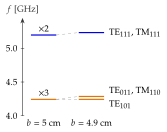
In a cube , so every permutation of the indices that is an allowed mode gives the same frequency. Changing one side lifts only the degeneracies that involve that side.
, and
- : TE, TE, TM, three modes,
- : TE, TM, two modes,
- : TE, TE, TE, TE, TM, TM, six modes.
TE does not involve and stays at . TE and TM both contain and move up together:
The triple splits into a single mode at and a pair higher. TE and TM rise from to and stay degenerate.
At . The squeezed box is still almost a cube, so and . The split is bandwidths: the modes are fully resolved.
A vertical probe couples to . TE has , maximal at the probe. TE has only (), and TM only (). Only TE is excited.
The relative shift of the pair, , is half of the change of , as expected: contributes half of for these two modes.
In a perfect cube three different field patterns share one frequency, and any small asymmetry (a dent, a screw, a probe) mixes them. Single-mode cavities avoid equal sides. Dual-mode filters do the opposite: they use two degenerate modes of one cavity on purpose and couple them with a screw, getting two resonators from one box.
cf. Problem 7.8.1