Section 7.8 · Further exercises · 1 of 10
Exercise 7.8.1: A frequency read from a sliding short
Ten further exercises in the spirit of Problems 7.8.1–7.8.5 and the home exercises, graded from easy to harder. Exercises 7.8.1–7.8.6 are about cavity resonators, Exercises 7.8.7–7.8.10 about microwave devices and scattering parameters. They use only the results of this section, in particular , of Eq. (7.8.24) with ( for a cube), of Eq. (7.8.33), , , , the response with , and for S-parameters , reciprocity , losslessness , and .
A frequency read from a sliding short
#A length of air-filled WR-90 guide (, ) is closed by a fixed wall at and a sliding short at . A weak source of unknown frequency drives the TE mode through a small hole, and a detector shows a sharp resonance at the plunger positions , and . (a) Find and the frequency. (b) Name the three resonances. (c) Where would the resonances appear at ? (d) Each position is read to . Which reading gives the frequency most precisely, and how precisely? (e) Can the plunger find a resonance at ?
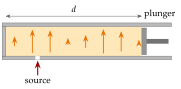
The source excites only TE, and the cavity resonates whenever the plunger stands a whole number of half guide wavelengths from the fixed wall, : the resonances TE. Consecutive positions are apart, and gives the frequency through with .
The positions are apart, so . With ,
and .
, and : TE, TE and TE of three different cavities, all at . Check with the cavity formula: .
At , , and : resonances at , and .
Each reading gives , so a reading error of becomes in : the farthest resonance () is best. From ,
so in is . The first reading alone would give .
No. is below the TE cutoff of , so is imaginary and no plunger position satisfies . Every resonance of the TE family lies above .
(), as for every guided mode above cutoff. At the TE mode of WR-90 () is still cut off, so only TE resonances appear.
This is the shorted-guide picture of a cavity in its simplest form: the cavity is the guide with chosen to fit the standing wave. Moving the plunger by from one resonance to the next is a direct, absolute measurement of that needs no calibration of the frequency scale.
cf. Problem 7.8.1