Section 7.8 · Home exercises · 4 of 4
Home exercise 7.8.4: A circulator protects the magnetron
A circulator protects the magnetron
#A magnetron feeds an industrial oven through a circulator (port ). Port 3 ends in a matched water load. The oven reflects with .
- Write of the ideal circulator. Is it lossless? Reciprocal?
- Ideal circulator: where does the reflected power go, and how much is it?
- A real circulator has insertion loss and isolation. How much power returns to the magnetron?
- What would return without the circulator?
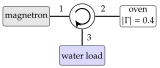
Follow the power round the circulator: with the insertion loss, the reflection at the oven, then (wanted, into the load) and (unwanted, down).
Its columns are orthonormal, : lossless. : non-reciprocal. All : matched.
: return from the oven to port 2 and are routed entirely to port 3, into the water load. The magnetron sees a perfect match.
is a factor . The oven receives and reflects into port 2. Of this, ( isolation), , leaks back to port 1, and reach the water load.
Without the circulator the full return to the magnetron, which sees a VSWR of .
Power balance of the real case: (to the oven) (lost in the circulator on the first pass), and , the last term being the circulator loss on the way back.
The magnetron is pulled off frequency and overheats when it sees a strong reflection. The circulator turns a VSWR of into an equivalent (VSWR ), at the cost of , about of heat in the ferrite.